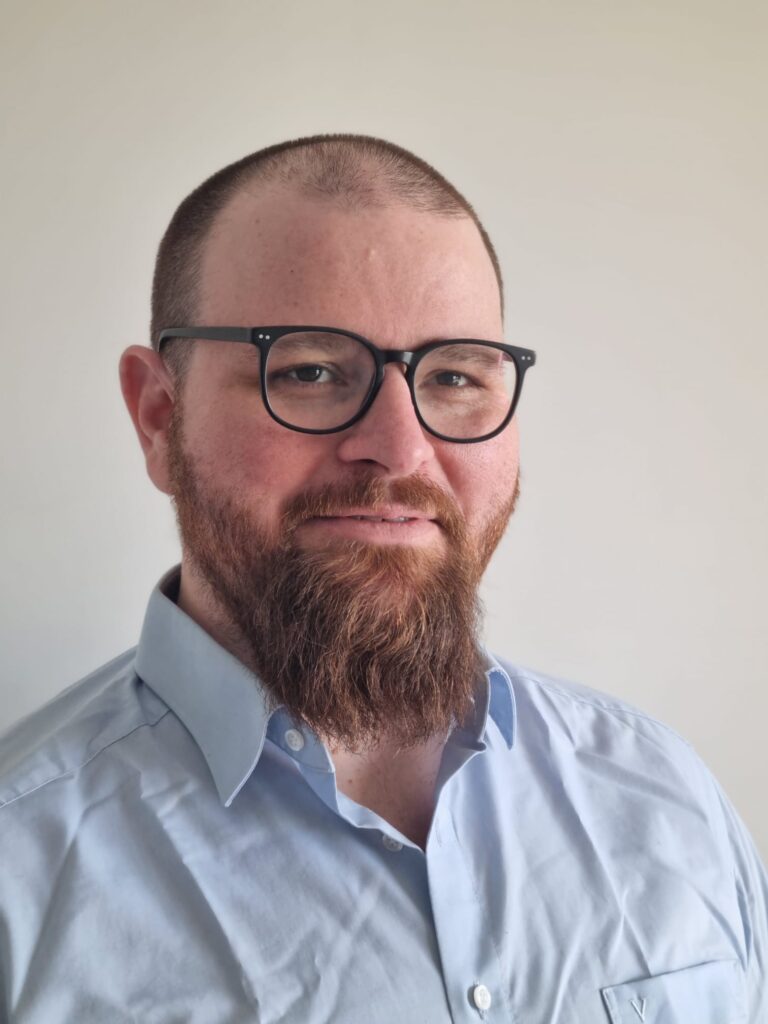
Matthew Rich-Tolsma (he/him) is a South African group-analytic therapist, independent scholar, and artist-educator based between the Netherlands and South Africa. His work bridges clinical practice, pedagogy, and organisational development, supporting leaders, educators, and teams to stay in dialogue when pressure is high and the stakes are real. He brings together group analysis, critical pedagogy, and critical theatre, with a focus on how trust, authority, conflict, and belonging shape what becomes possible in groups.
Clinically, he works in private practice with individuals, couple, and groups in Amsterdam. He also teaches in clinical training, and leads reflective practice. As a teacher, he works across higher education, including teaching and supervision in arts education, organisational behaviour, and entrepreneurship and innovation.
He is an experienced Nonviolence practitioner and mediator, and has worked with humanitarians and community actors in contexts of armed conflict, including in Iraq, Syria, Sudan, and South Sudan.
Alongside rigorous facilitation and the design of learning processes, Matthew integrates mindful and embodied practice to support steadiness, discernment, and care. He is interested in the quieter dimensions of relational work as well, including attention, silence, and the felt sense of what is happening in a space.
What others say…
Maaike Lauwaert, Chair of the Executive Board, Gerrit Rietveld Academie
“When I first encountered the collaborative practice by Lotte van den Berg and Matthew Rich Tolsma, I was struck by how they succeed in not using art in service of policy or societal agendas, but rather allow art to operate as a space for thinking and acting – a space to which we are all invited – and a space in which such agendas can genuinely shift. Their practice moves with great precision and incredible openness and care, along a rare and fragile threshold: maintaining artistic integrity while at the same time generating real impact within institutional, pedagogical, and governance contexts. In my experience, there are very few practitioners—nationally or internationally—who so convincingly bridge these worlds. They do not collapse these domains into one another, nor do they seek easy synthesis. Instead, they take the tensions between them, and tensions as such, seriously and work with them productively. Institutions, public spaces, and collectives are approached as living social sculptures—sites where friction, uncertainty, and difference are not problems to be solved, but conditions for learning, coexistence, and transformation”.
Prof. Barend Erasmus, Former Dean of the Faculty of Science, University of Pretoria; Professor, GIBS (Johannesburg)
“I really enjoyed working with Matt; he has a quiet authority that comes from deep knowledge. It is easy to underestimate the skill that goes into enabling real co-production. We had a few instances where our co-production processes were challenged by participants and this is where Matt’s skill and insight really became valuable. Without it, we would not have had the outcomes we were hoping for. Oh, and he’s a really nice guy too”!
Cormac Burmania, Director of Bachelor Artist-Educator in Theatre, ArtEZ University of the Arts
“Throughout his leadership, Matthew demonstrates an unwavering commitment to systemic reflexivity, relational ethics, and the embodiment of critical pedagogy as a lived educational and organisational practice. His leadership is grounded not only in technical expertise but in a deeply human, ethically attuned engagement with the realities of educational life, recognising that real transformation requires addressing not only structures but also hearts, minds, and relationships”.
Adam Warne, Eperienced CTO, AO.com; N Brown Group; River Island; JD Sports; Zonal
“Matthew worked with our business on what was badged as exec coaching, but with hindsight this feels like a disservice to what was actually delivered. He has an amazing ability to tell you like it is with the emotional intelligence to deliver it in a meaningful and actionable way. One of the brightest people I’ve had the pleasure of meeting and thoroughly enjoyed all of our interactions”.
Prof. Joris Knoben, Dean of Research, Tilburg School of Economics & Management
“Throughout his work, Matthew consistently models a form of educational leadership that is dialogical, complexity-aware, and ethically grounded. He does not view curriculum or institutional structures as static entities to be managed, but as living systems requiring ongoing relational care, critical reflection, and courageous innovation. His leadership supports the development not only of new courses but of new institutional imaginaries — ways of thinking and practising that respond more creatively and responsibly to the challenges of our time”.
Maritska Witte, Director, ArtEZ Academy of Theatre & Dance
“His policy and leadership work are nothing short of revolutionary—grounded in theoretical sophistication and embodied participatory processes, yet also pragmatic and implementable. These capacities have already begun to influence conversations at the most senior levels of the institution, including executive strategy and governance planning.
Matthew’s proposal to reimagine governance as a relational, dialogical, and aesthetic process aligns strongly with both his current work and the broader mission of ArtEZ to cultivate ethical, innovative, and socially engaged forms of learning and institutional practice. His unique integration of critical pedagogy, decolonial theory, complexity thinking, and artistic research is particularly valuable at a time when educational and cultural institutions must navigate increasing uncertainty and systemic complexity, as are their students”.
Prof.dr.ir. Timo Heimovaara, Professor & Former Head of Department (Geoscience & Engineering), Delft University of Technology
“Matthew’s contribution at TU Delft demonstrates what sustained, strategic educational leadership looks like in practice. He worked with exceptional sensitivity to context and a deep understanding of complex institutional systems. He engaged with us as partners, not clients, helping us to think and act differently rather than prescribing solutions. His ability to work fluidly across multiple levels—individual, team, and organisational—was key to the success of this transformation.
Even after his formal involvement concluded, the practices and principles he introduced have remained alive within the department. The language of dialogue, reflection, and shared responsibility now informs how we approach leadership and collaboration. The work has also influenced how new academic and administrative leaders are prepared for their roles, with several of the concepts first introduced by Matthew now woven informally into our leadership conversations and mentoring.
I can say with confidence that Matthew’s work at TU Delft has had a lasting and transformative impact on both individuals and the institution. He has shown that in a technically driven environment, it is possible to cultivate empathy, reflection, and ethical engagement as organisational capacities. His leadership exemplifies the kind of integrity, creativity, and systemic awareness that higher education urgently needs”.
Selected Publications & Presentations
Rich-Tolsma, M. (2026, January 24). Living the pedagogy of hope. Keynote presented at the Annual ArtEZ Artist-Educator Study Day, ArtEZ University of the Arts.
Rich-Tolsma, M. & van den Berg, L. (2025, October). Paradox as Praxis: Toward a Living University of the Arts. Paper presented at the Annual Meeting of the Dutch Sectoral Advice Commission for Art Education (SAC-KUO), Willem de Koning Academie (Rotterdam).
Rich-Tolsma, M. (2025, September). Decoloniality, Whiteness, and Group Analysis. Paper presented at the Institute of Group Analysis Conference, Glasgow.
Rich-Tolsma, M. (2025, April 24). Build the ship while sailing: A phronetic approach to navigating complexity. Paper presented at the 2025 Sociocracy Conference, Sociocracy For All (SoFA).
Rich-Tolsma, M. (2025, April). Emotions as embodied, social, and aesthetic processes: Toward a world-centric pedagogy for addressing wicked problems. Paper presented at the EMESER Symposium: Educational perspectives on emotions in teaching and learning for sustainability – Conceptualisations, methodological questions, empirical insights, and pathways for future research. WERA Research Network Emotions in Environmental and Sustainability Education (EMESER).
Rich-Tolsma, M. (2025, April 3–6). Embodied wisdom: Decolonizing psychoanalysis with Afrikan epistemologies. Paper presented at the 44th Annual Spring Meeting of the Society for Psychoanalysis and Psychoanalytic Psychology (APA Division 39).
Rich-Tolsma, M. (2025, March 10–11). Rupture and recognition: Gendered power, misrecognition, and transformation in group interactions. Paper presented at the 7th Global Congress on Gender and Sexuality Studies, Sciinov Group.
Rich-Tolsma, M., & Mqalo, S. (2024). Decentering whiteness in South Africa: Using empathic dialogue to engage with race, identity, privilege, and entitlement. In P. Farvid (Ed.), Sexual racism and social justice: Reckoning with white supremacy and desire (pp. 315–332). Oxford University Press. https://doi.org/10.1093/oso/9780197605509.003.0016
Hampson, G. P., & Rich-Tolsma, M. (2022). Coalescing and potentializing integrative higher education: Complex thought, critical realism, integral theory, and a meta-matrix. In N. Hedlund & S. Esbjörn-Hargens (Eds.), Big picture perspectives on planetary flourishing: Metatheory for the Anthropocene (pp. 159–174). Routledge. https://doi.org/10.4324/9781003140313-11
Hancil, T., & Rich-Tolsma, M. (2021). Applications of adaptive leadership in Central and Eastern European contexts. In M. Raei & H. T. Rasmussen (Eds.), Adaptive leadership in a global economy: Perspectives for application and scholarship (pp. 296–312). Routledge. https://doi.org/10.4324/9781003099109-16
Rich-Tolsma, M., & Oliver, J. (2016). Addressing the complexity gap: Developing integrated thinking capacity in boards. Board Leadership, (146), 1–8. https://doi.org/10.1002/bl.30034
Hampson, G. P., & Rich-Tolsma, M. (Eds.). (2013). Leading transformative higher education: Studies, reflections, questions. Palacký University Press.
Rich-Tolsma, M., & Assenza, G. (2013). Transformative leadership & higher education: An encounterbook. Palacký University Press.
Current Roles
Group Analytic Therapist, Private Practice
Independent organisational consultant, mediator, and coach, at large
Co-founder, Not without the Rose: Workspace for Social Sculpture
Pedagogue-in Residence, ArtEZ University of the Arts
Associated Researcher, Art Education as Critical Tactics (ArtEZ)
Lecturer & Examiner, Tilburg University
Convenor (Foundation Certificate in Group Analysis), Turvey Groupwork
Guest Faculty (Diploma in Reflective Practice in Organisations), Institute of Group Analysis
Leadership Roles
Former President of the Board of Directors, Center for Nonviolent Communication (USA)
Former Trustee & Director, Institute of Group Analysis (UK)
Former Executive Director, Rise Beyond, Ltd. (UK)
Managing Director, Ashby Trade & Investment (Property Investments), (Pty.) Ltd. (South Africa)
Director, Giraffe Educate Foundation (Uganda)
Member of the Board of Directors (Treasurer), Body of Art (The Netherlands)
Board Member, Pedagogy & Theatre of the Oppressed, LLC (USA)
Selected Credentials
Principal Fellow of the Higher Education Academy (PFHEA), Advance HE
Fellow of the Institute of Educational & Social Equity (F.InstESE), Institute for Equity University Centre
Professional Fellow, Institute of Coaching
Fellow, Royal Society of Arts
Master of Philosophy (Complexity & Management), University of Hertfordshire
Certified Trainer, Center for Nonviolent Communication
Postgraduate Certificate in Traumatic Stress Studies, Trauma Research Foundation
Certified Somatic EMDR Practitioner, Embody Lab
Certified Facilitator, The Work that Reconnect
Certified Mindfulness Coach, Unified Mindfulness
Advanced Professional Scrum Master (PSM II), Scrum.org
Certified Security & Risk Management Professional (SRMP-C), INSSA